


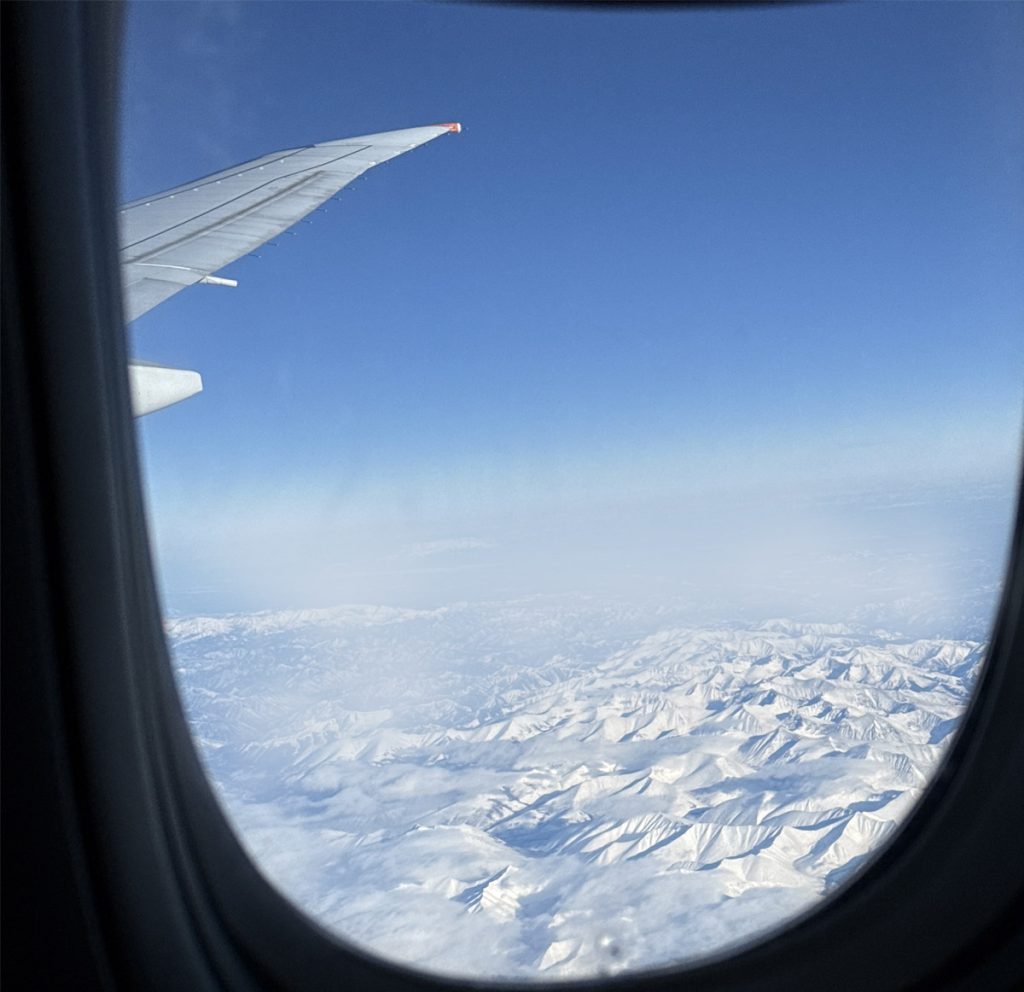
I am writing these lines on an Aeroflot Boeing 777-300 ER aircraft, flying at an altitude of 9,754 meters and traveling at 832 km per hour, on my 8.5-hour return journey from Sakhalin Island in Russia’s Far East to Moscow, where I had gone to attend the ninth Sakhalin Jazz Festival held this year. Rather than sleeping as we pass over the mountains covered in ice that resemble the endless expanse of the Aldan region, I choose to write these lines, which I am eager to share with you. I wanted to write both a travel diary and notes from the festival.
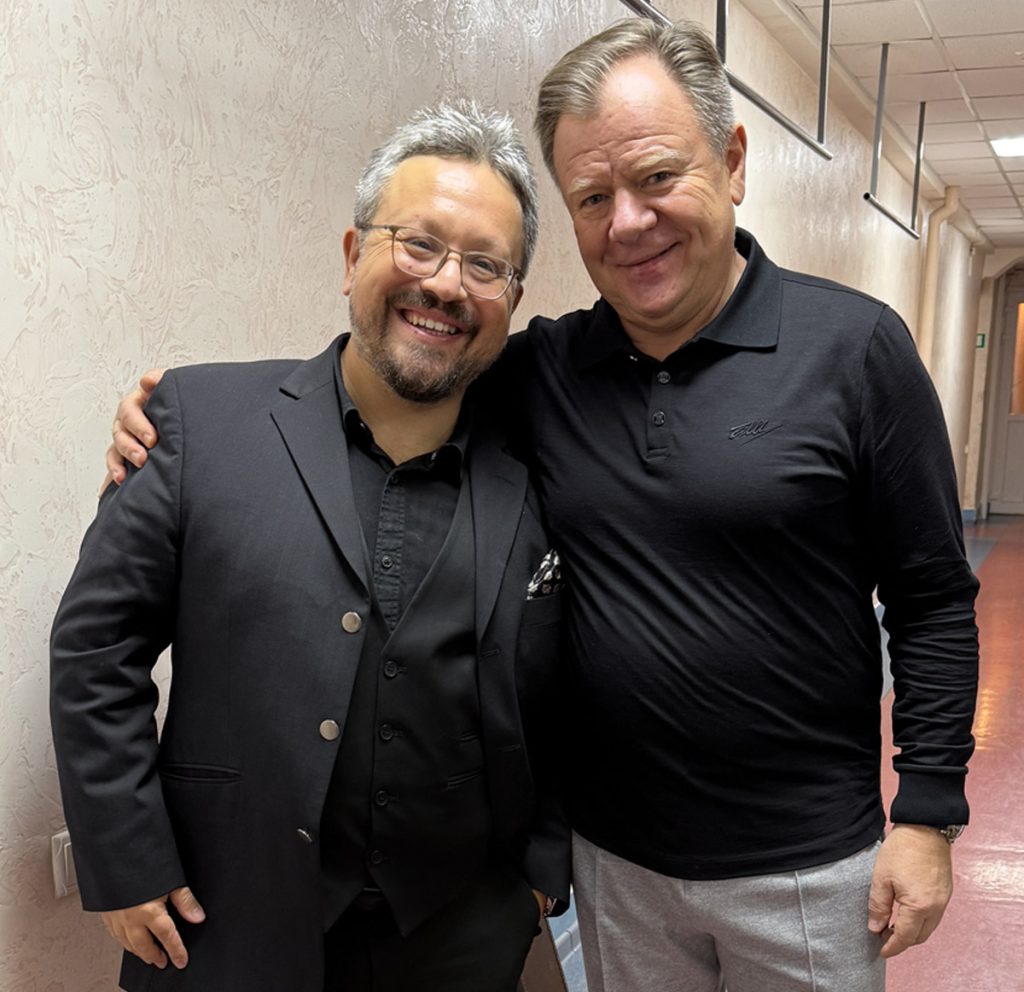
A few months ago, after the concert at the Jazz Seasons Festival held for the first time at Arkhangelskoye Palace, 20 km west of Moscow, Igor Mikhailovich Butman, Russia’s jazz ambassador and People’s Artist of Russia who organizes many festivals across the country every year, told me, “You absolutely must come to the Sakhalin Jazz Festival this year. you won’t believe the spirit there.” When Butman, whose word I deeply respect, recommends something to me, it means he wants me to see new worlds. Taking into account that it would take about a day to get there and a day to return, including airport waits, I set off for Sakhalin Island, which even many Russian citizens have never seen due to its geographical location. I can’t be more happier by my desicion.
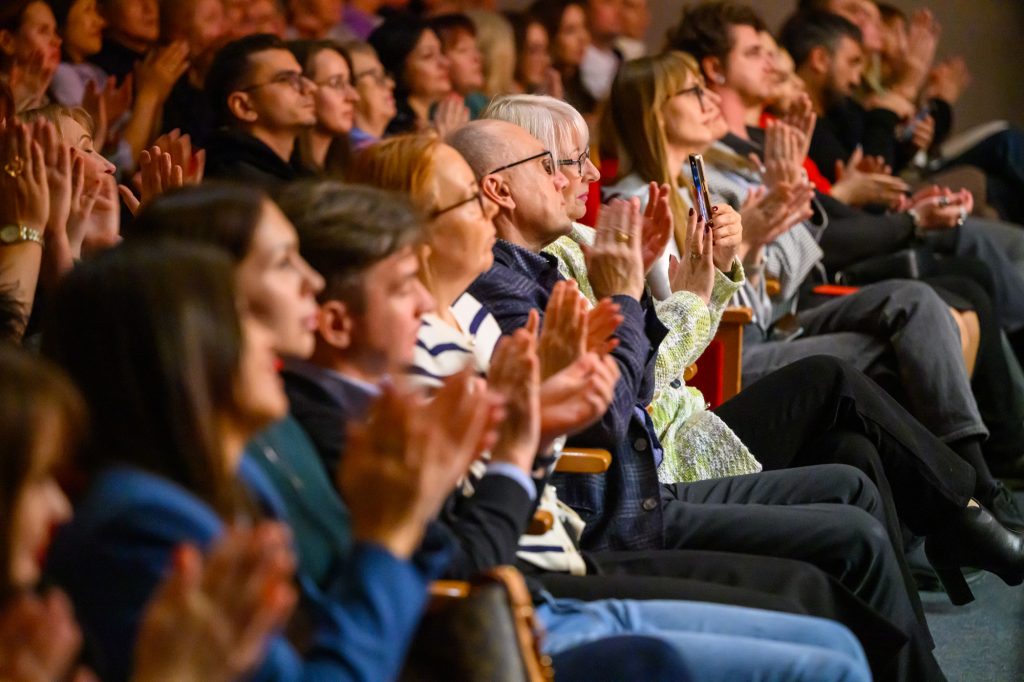
I must admit that it was one of the most memorable experiences of my life. I am used to seeing interest in art in centers like Moscow and St. Petersburg, but the Sakhalin people’s embrace of art, with passionate music lovers filling the concert hall even this far away, is the result of an artistic and aesthetic tradition that has been woven into the fabric of Russian life for generations. I observe that the audience profile consists mostly of young people, but quite a few middle-aged music lovers also show interest in the events.
What is the aim of Sakhalin Jazz Festival?
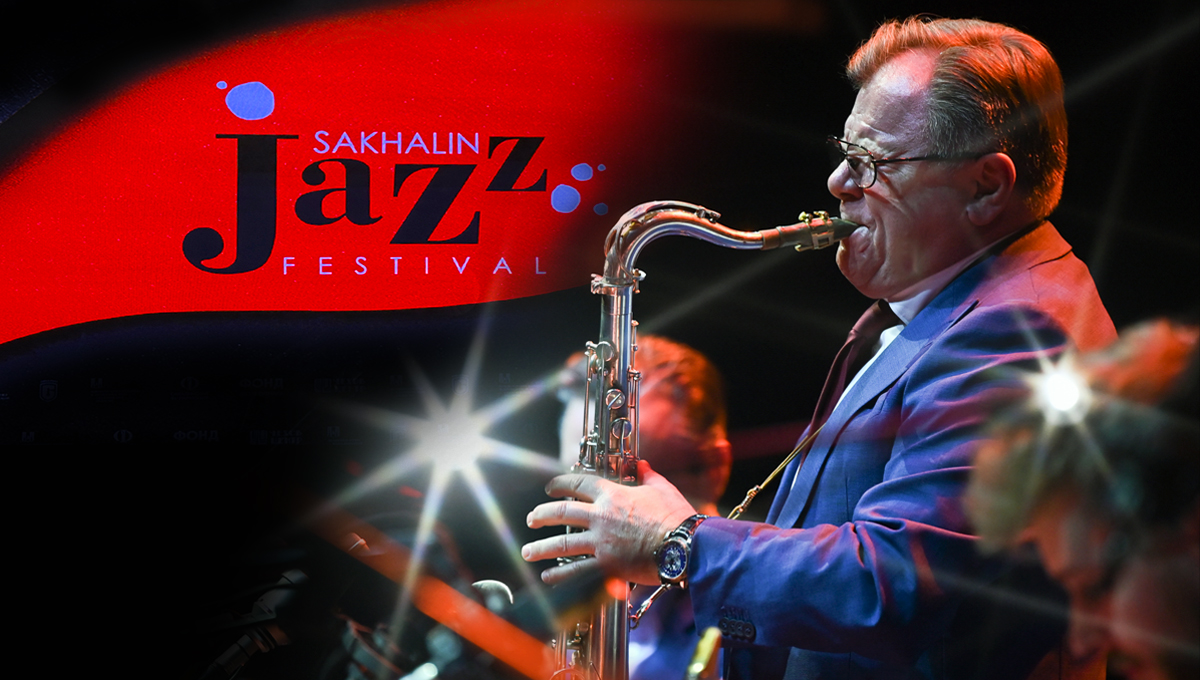
The Igor Butman Foundation for the Support and Development of Musical Arts is inspired by Plato‘s words: “Good deeds empower us and encourage others to do the same.” The Sakhalin Jazz Festival, previously held jointly with Japan but transformed due to the cancellation of direct flights as a result of the current political situation, aims to bring jazz and improvisational music to a city in a remote part of Russia with limited cultural access, to inspire it, and to ensure the continuity of this musical culture.
The Sakhalin Jazz Festival brings a wealth of jazz to Sakhalin, featuring improvisation-based music that is easy to relate to, and strives to increase enthusiasm for jazz through master classes and discussions.
Big band music is one of the cornerstones of jazz. It is an infinitely versatile production space where you can experience the discipline, improvisational possibilities, hierarchy, and group interaction of jazz music in a single form. Each performance contains new musical stories that you will experience breathlessly, as the arrangements allow.
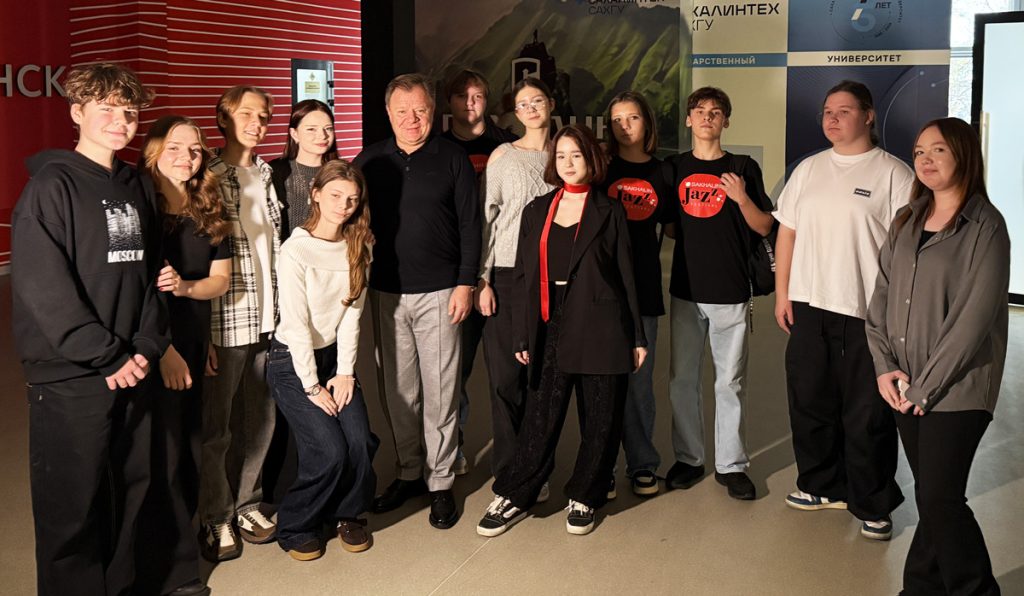
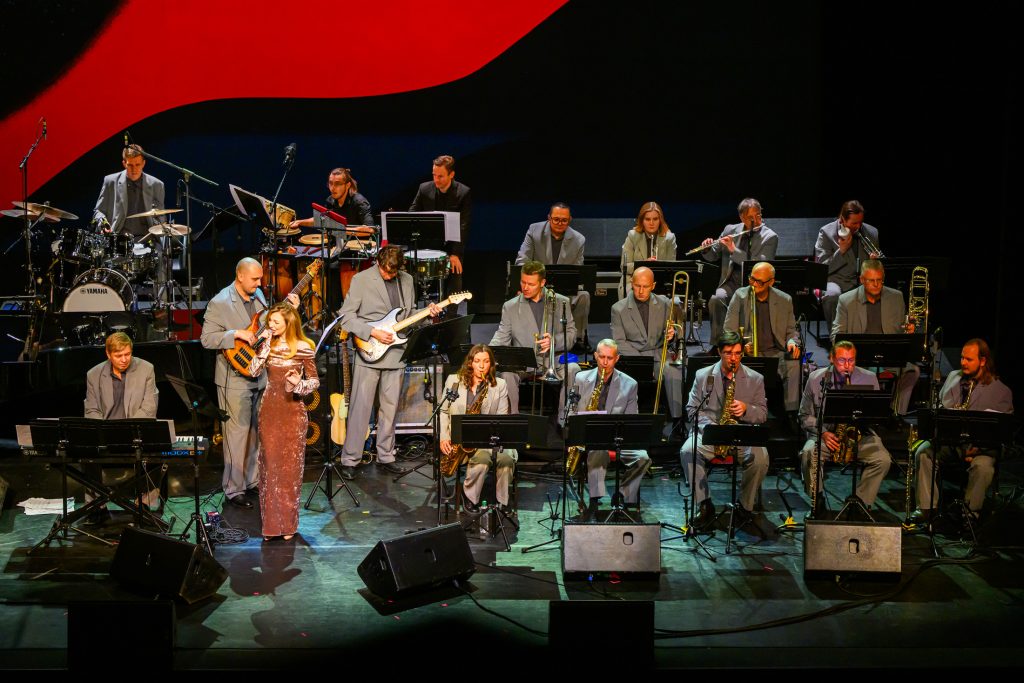
The big band tradition, one of the most valuable elements at the root of jazz, particularly represented by Igor Butman and the Moscow Jazz Orchestra, holds a very important place in Russian jazz. One of the most important fruits of this is the Igor Butman Moscow Jazz Academy Big Band, established by the Igor Butman Foundation and funded by Russian government where teenagers aged 15-17 receive training. Having been founded just last year and performing for the first time this year at the Moscow Jazz Festival on the free public stage at Zaryade Park, The Sakhalin Philharmonic Jazz Orchestra also performed at the opening of the Sakhalin Jazz Festival at the Chekhov Center . Both orchestras performed for the first time on two evenings of the festival and received enthusiastic applause from the audience.
Before writing about the concerts, let me tell you a little about my time in Sakhalin. The refined taste of tuna fish caught just a week earlier in the Pacific Ocean and my walks in its oxygen-rich nature were unique. Sakhalin Island is a developed island thanks to gas mining, and it is also a key location and a prosperous place due to its role as a bridge to the Far East.
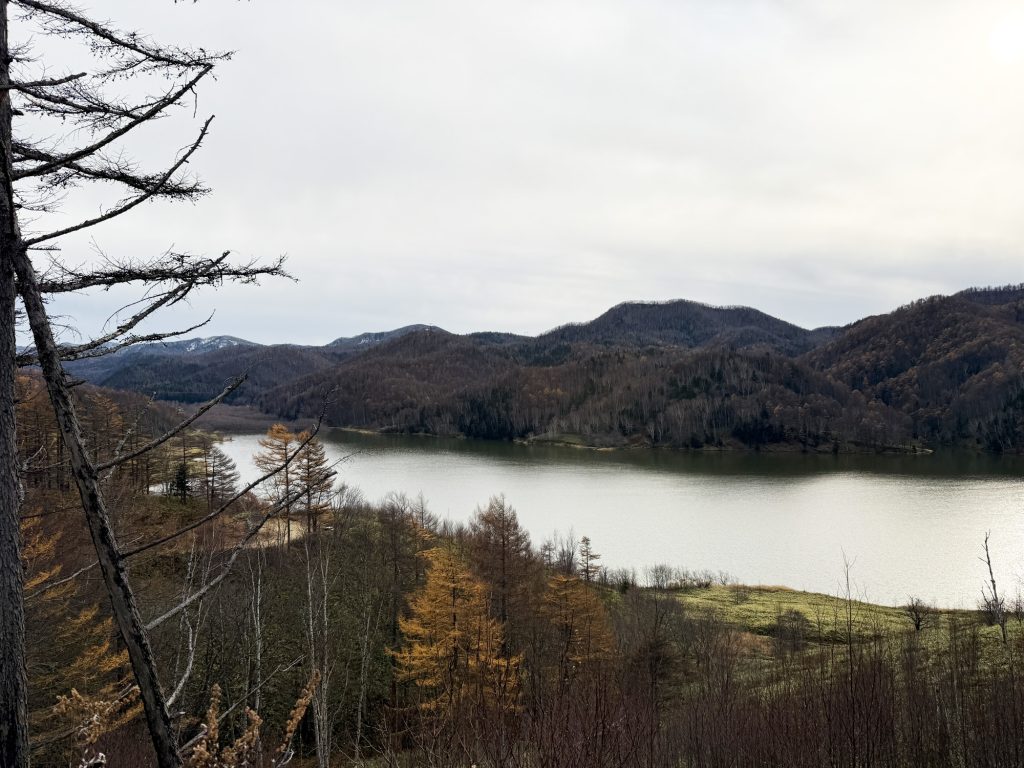
Unlike the hectic metropolitan festivals with their intense schedules, Sakhalin has a sense of tranquility. The musicians’ joy and ease before the concerts, their preparations by showing each other performance videos, and the leisurely conversations during the post-concert dinner, at breakfast, and on the way back to the hotel after the concert added to my musical vision. I had time to examine each of their life stories, working practices, and human aspects in more detail. I offered them criticism from a spectator’s perspective.
Sakhalin Island is located at the farthest corner of the Asian continent, bordering Japan. The Asian continent, which begins at the Bosphorus Strait on one end, ends at Sakhalin on the other. The island, which was handed over to Russia by Japan after World War II, still bears traces of Japanese architecture and spirituality. The island’s magnificent nature, where I observed Japanese and Korean features in a large part of its population, seems worthy of being the subject of novels. The trees, lush with abundant rain and reaching up to the sky, are rare beauties from the Japanese flora. In this month of November, where snowfall is common, mostly cold and light rain, and sometimes clear skies are observed, the yellowing and reddening coniferous trees greatly reinforce the image of Japan in my mind.
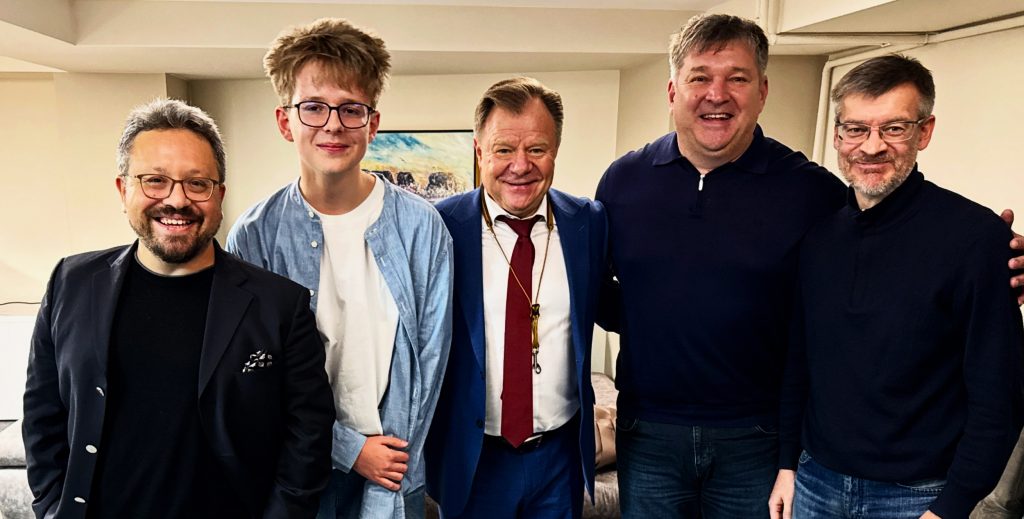
During one concert, I met Ivan Fedorchenko, a native of Sakhalin and owner of a construction company, and had the opportunity to become friends with him. In his words, the people of Sakhalin are hospitable, friendly, and peaceful. I feel blessed that I can say that I experienced enough during my short stay on the island to agree with his words.
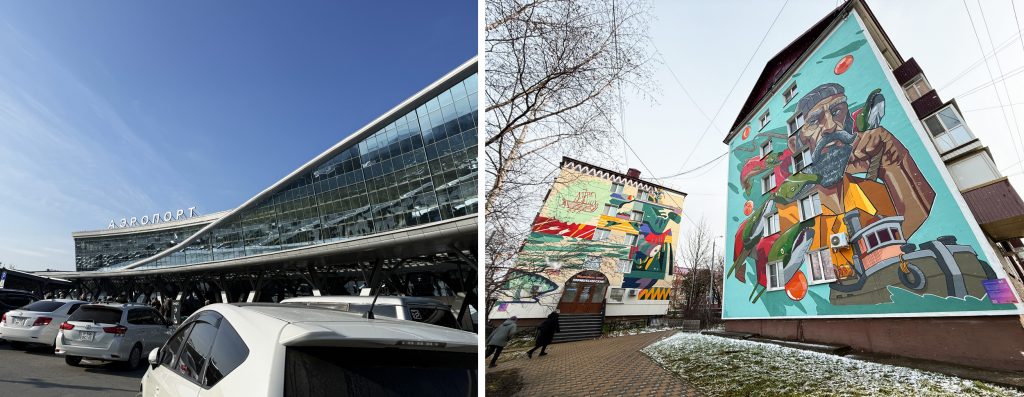
As I passed from the small but modern-looking airport to the city center, the buildings decorated with murals, wide streets, and calm traffic shattered my preconceptions about encountering a dilapidated place within the first minute.
Where to visit in Sakhalin?
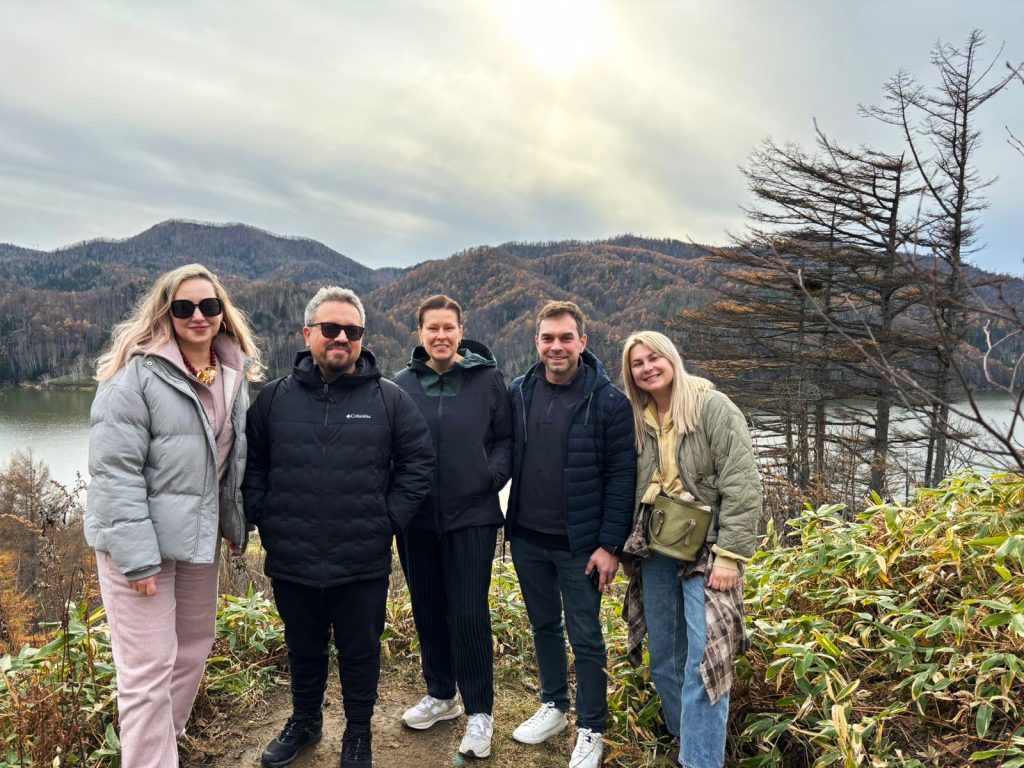
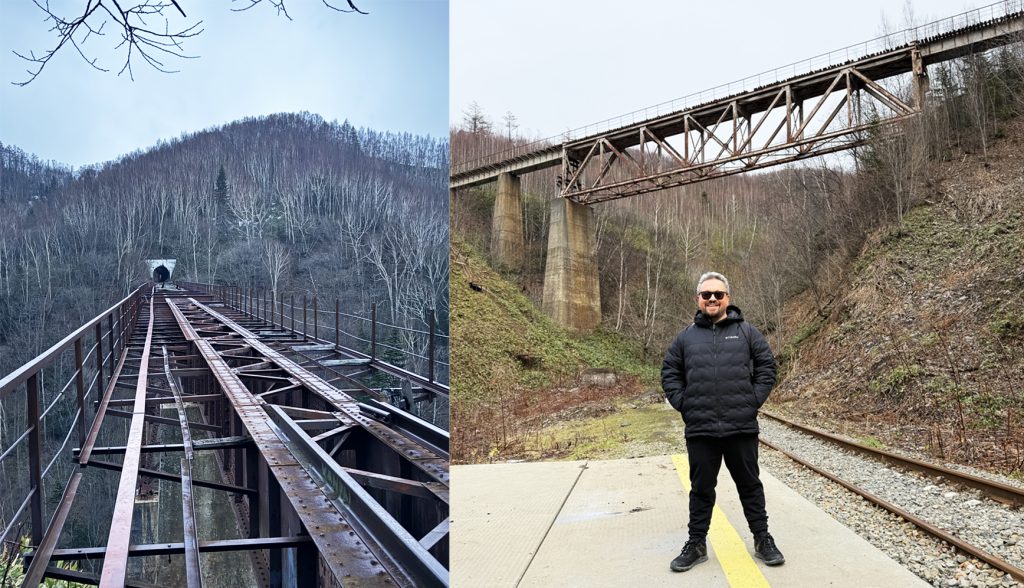
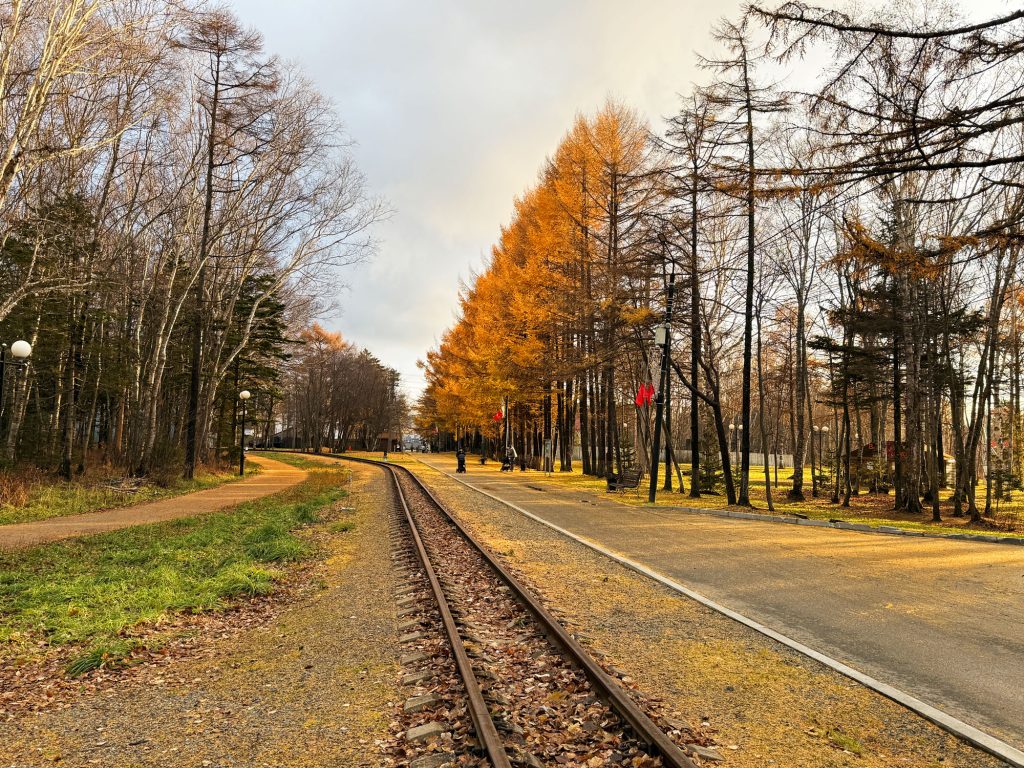
On our first day in Sakhalin, we toured the railway region stretching from Yuzhno-Sakhalinsk to the Kholmsk area with our friends from the festival managing team. The Japanese began construction of the first line here in the 1920s, and it was later rebuilt with the labor of Russian and Korean workers. After hiking along the section of the line that still remains today, passing through the mountains, and which is even open to train services once a day, we took a trip to the now-disused Devil’s Bridge area, which can only be visited with a professional guide. Starting from the Тайное (Secret lake) area, we took a forest walk accompanied by Russia’s unique natural scenery, passing through disused tunnels, partially destroyed bridges, and a challenging forest hike along the train track line into the forest. At the end of our 6-hour tour, we shook off our fatigue with hot tea (with whiskey, of course) and tasty dried apricot and Sakhalin marmalade. They say, “If you want to get to know someone, go on a trip together.” Once again, I realized that Russians are excellent travel companions even under difficult conditions. Throughout the journey, which became challenging at times, they made it unforgettable for me with their constant help and friendship. I need to admit that sometimes I get nervous for that kind of trips but they were always with me in every single moment with their endless patience. I would like to take this opportunity to thank my travel companions once again hope we can find an opportunity like this again.
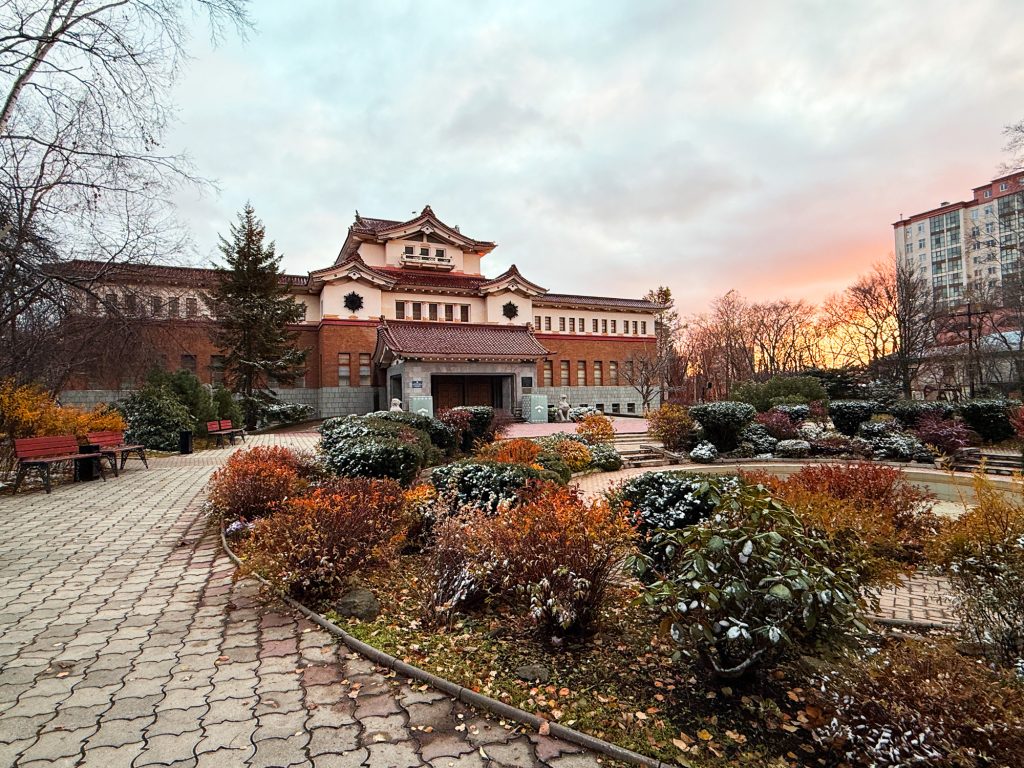
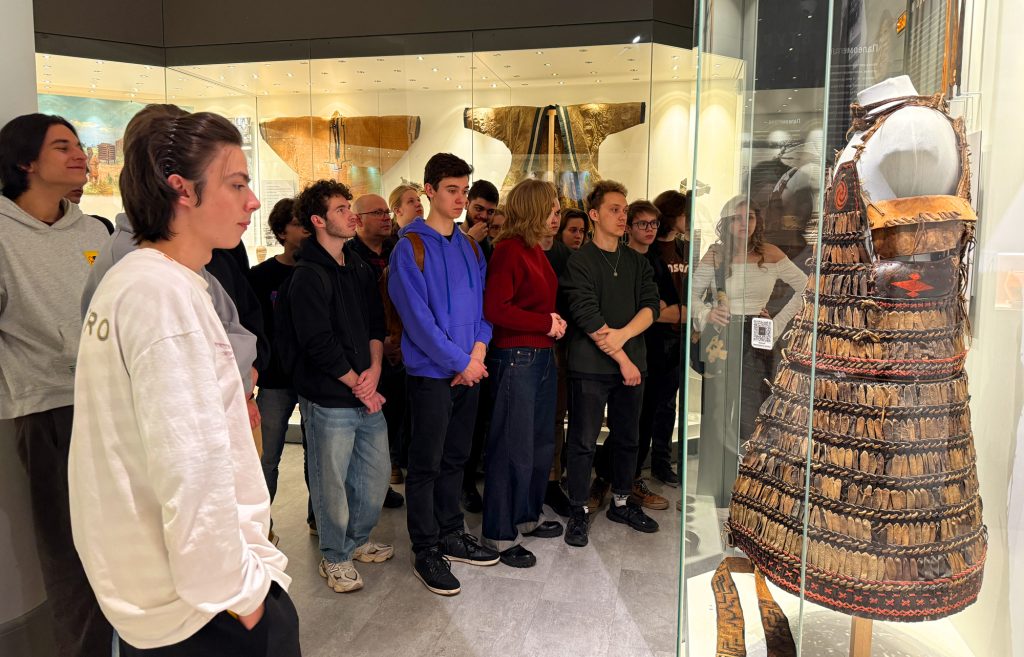
One of the most important places to see on Sakhalin Island is the Sakhalin Regional Museum. Built in the imperial crown style, the museum is a typical Japanese building whose construction began in 1935 and was completed in 1937, before coming under Soviet administration in 1945. From the pond in front of the museum to the lion statues and landscaping, its beauty will transport you from Sakhalin Oblast to Japan. Inside the building, there are many special exhibits, from traces of wildlife living on Sakhalin Island to personal belongings of communities that have lived on the island over the years and various artifacts.
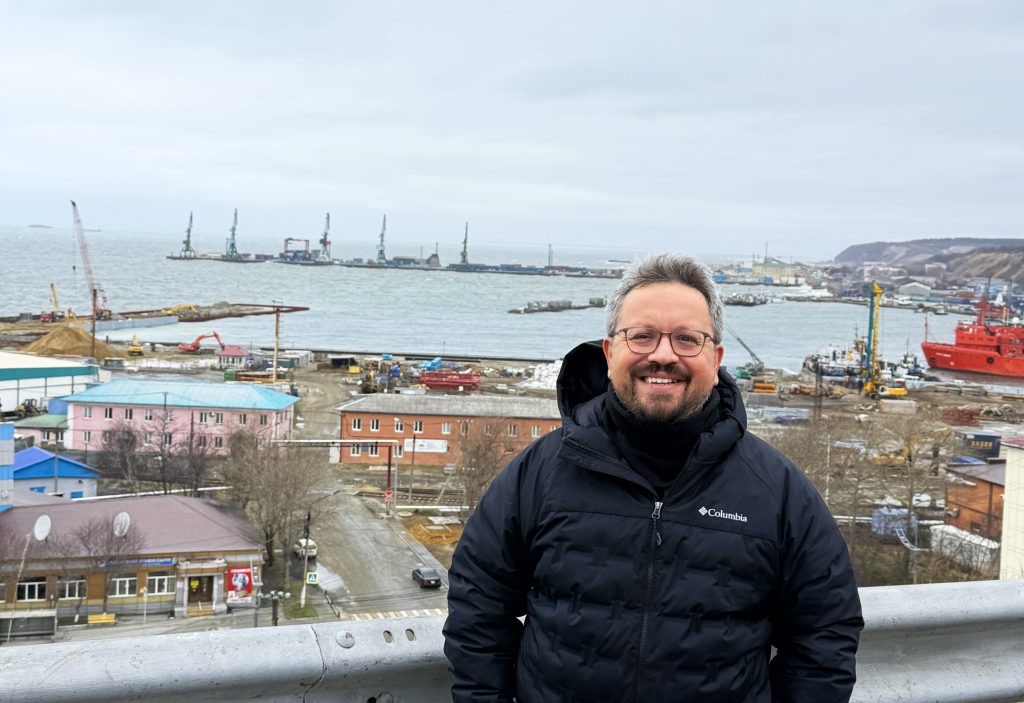
Another stop during my days in Sakhalin was Korsakov (Корса́ков), a port city in Aniva Bay at the southernmost tip of Sakhalin Island, where the freezing winds blowing in from the Pacific Ocean redefined the meaning of cold. Our closest point of contact with the ocean was the tourist resort of Prigorodnoye (При́городное), whose massive waves were unforgettably beautiful. This journey, where you could only stay outside of the car for a short time due to the cold at this time of year, was one where you would marvel at its magnificent nature while traveling mostly by vehicle. It is said that on clear days from these points, you can see Hokkaido, Japan. This time, I could only imagine the opposite shores.
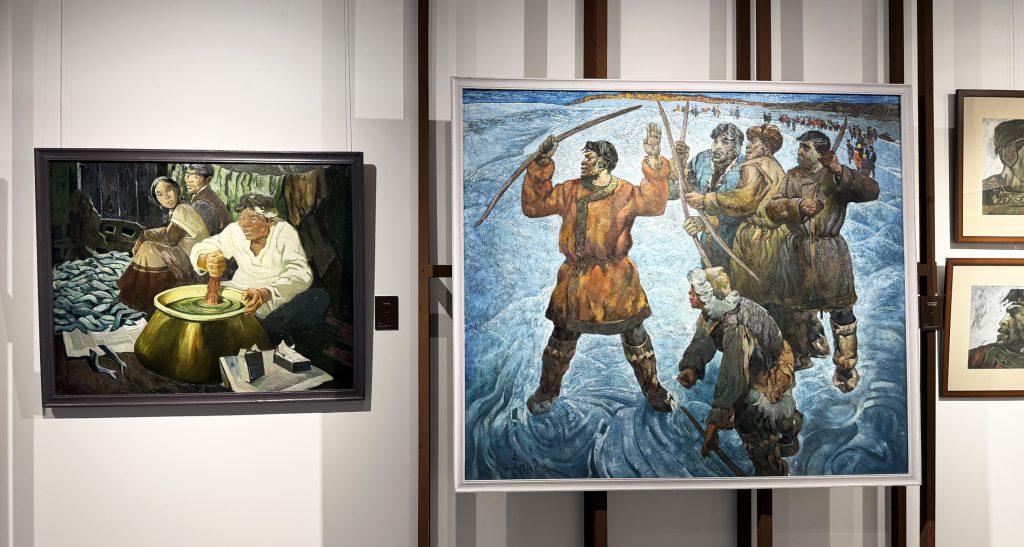
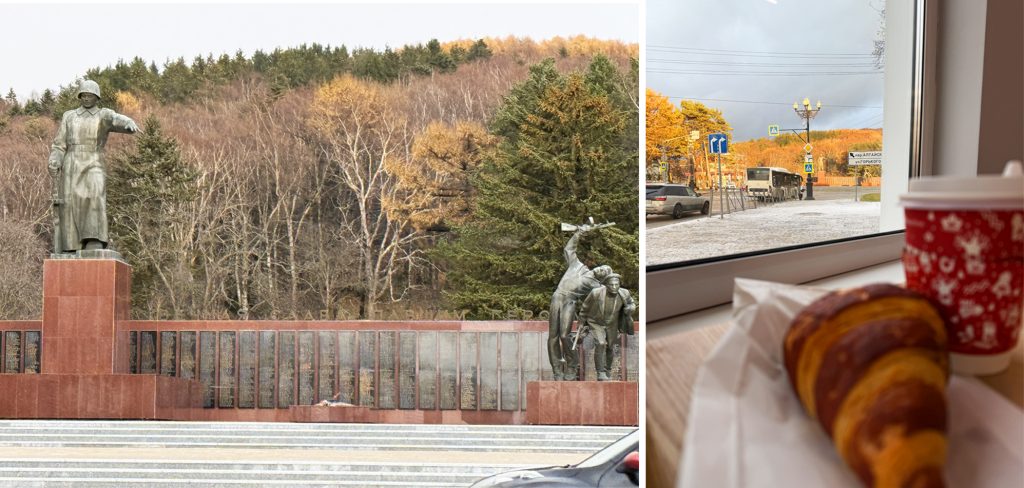
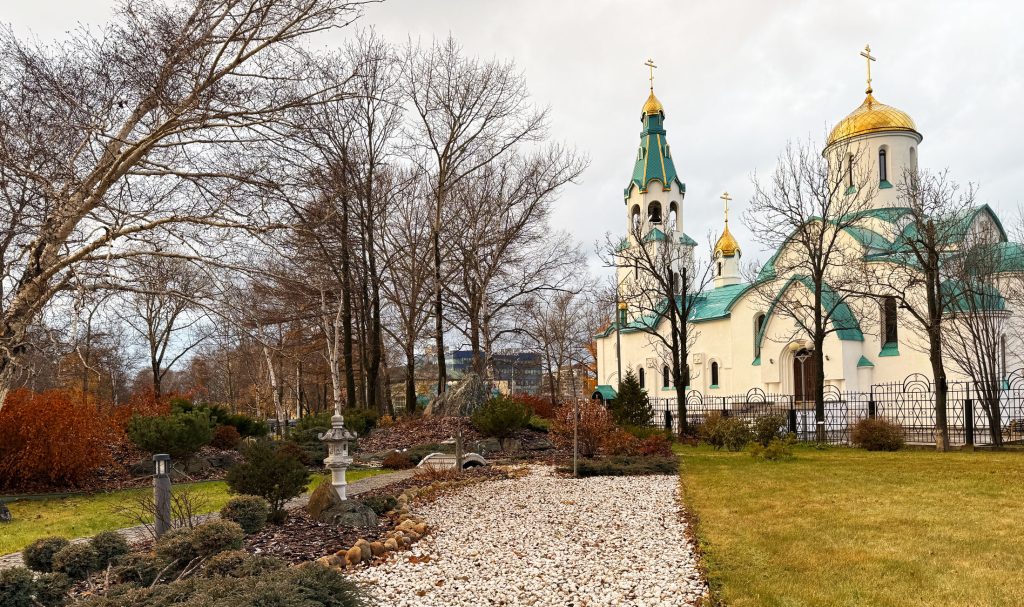
If you come to Sakhalin, I have a few more travel routes to recommend. Gagarin Park, (which also has a small lake inside) located right behind the hotel where I stayed, is one of the most pleasant parks in the city. It is quiet and clean. You can enjoy a coffee & chocolate croissant at the coffee shop on the corner while walking out of the back gate of the park, towards The Square of Glory, built in memory of the Soviet soldiers who lost their lives during World War II. The Sakhalin Regional Art Museum, one of Russia’s youngest museums, has been operating in a Japanese bank building since 1989 and houses over 7,000 works by Russian artists. You can also see paintings by local artist Mikhailovich Mankava, which depict the daily life of the Sakhalin people. As you walk towards the city center, The Cathedral of the Resurrection of Christ and the massive 1970 Lenin statue, one of many Lenin statues in Russia and the work of sculptor Yevgeny Viktorovich Vuchetich, can be interesting stops on your tour.
Why all the musicians are Russian in Sakhalin Jazz Festival?
All musicians performing at the Sakhalin Jazz Festival are musicians living in Russia. Being Russian is not a prerequisite, of course; on the contrary, the Igor Butman Foundation considers it very important for music lovers living in Russia to watch international musicians, but this wish cannot be fulfilled for a reason that is beyond their control and which I find very strange as a rationalist . You are aware of the Russia-Ukraine political situation right? When international musicians (whom I have personally witnessed), are invited to perform in Russia, they decline, saying they are waiting for peace. My words represent my own personal views and observations, in line with my respect for everyone’s way of working and opinions. You cannot judge me as a supporter of war. You are free to agree or disagree. Because there is no single right answer on this matter. But one question is universal: “So what is music’s fault in this political situation?” Or, in other words, “what is the sin of Russian music lovers whose lives could be changed by the music they listen to? Wasn’t music supposed to be unifying, a bridge of universality?” A leader musician should perform in both countries to show the world music has no political boundaries. Frankly, I see this issue as the US trying to seize the opportunity to impose cultural and political embargoes to control Russia, which is far beyond ahead of them in many areas, particularly productivity and diligence. However, the Russians are naturally very determined in their stance because they are self-sufficient in every sense with their own resources and the support of their allies. They may have problems with international integration, but when it comes to “independence,” whichever you prefer, you give the answer. I know musicians whose concerts have been canceled and who have faced pressure from festivals because they performed in Russia. I have personally witnessed that there is no security risk issue, and based on my observations, I believe that every artist who comes is treated in the best possible way. I invite everyone to act with common sense and rebuild bridges.
The Program of Sakhalin Jazz Festival
The festival kicked off on the evening of November 7 with a concert by the Sakhalin Philharmonic Jazz Orchestra. This was followed by an unforgettable Brazilian evening with Igor Butman, accompanied by his regular collaborators pianist Oleg Akkuratov, drummer Eduard Zizak, and bassist Nikolai Zatolochniy, along with vocalist Fantine. I had the opportunity to see Igor Butman and his stage companions couple of times live, who usually perform with a large orchestra, in a quartet format for the first time. The format allowed each musician larger space to perform. In addition to the arrangements by Akkuratov, a brilliant pianist and improviser, made to the bossa nova and samba repertoire with his own approach, the improvisations created on the spot for each piece were enough to heat up the night. Creative, soulful, brave and aggressive improvisations has been made. Throughout the concert, we listened to Letter to Pat, Desafinado, Só Danço Samba, Black Orpheus, Я иду шагаю по Москве, Corcovado, Aqua de beber, Girl from Ipanema, Mas Que Nada, Como in Bolero, and Бу-ра-ти-но from the movie The Adventures of Buratino, performed with passion by Russian musicians.
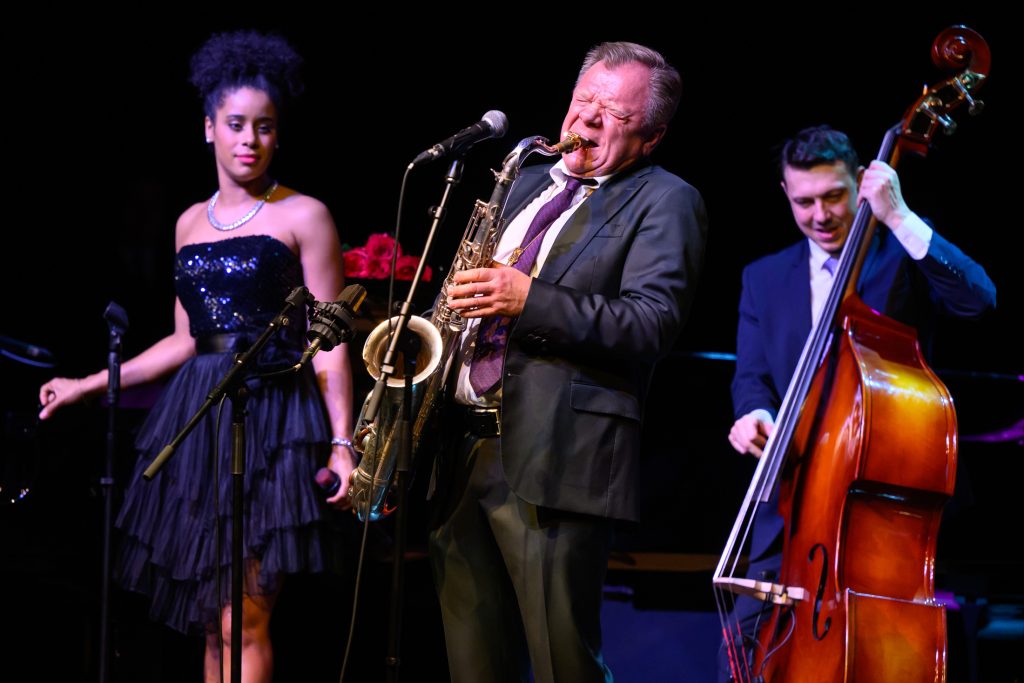
Master musician Igor Butman‘s playing has a Stan Getz-like character, angular and not every breath distinct, but rather he likes to play the melody as intertwining sounds. In his solos, he manages to chase after a new muse each time. As we heard at the festival, he sometimes inserts the main melody from Fascinating Rhythm or Prince Igor between solos, bringing smiles to faces. When he wants to extend his solos, he leans his saxophone back to his left side, varying his improvisation. When he wants to extend them further, he moves his body back and forth, converting his body’s static energy into the kinetic energy of his breath. He has earned respect by forming a bond of love with his orchestra, and he is a folk hero who always manages to keep the audience’s energy in his hands with his narrations and jokes between pieces.
Oleg Akkuratov is a diligent virtuoso perfectionist who speaks six languages fluently and constantly researches many subjects, from linguistics to musical genres, music history, and science. He has an entertaining side that you notice when chatting with him; sometimes when you say a word, he starts singing a song that contains that word. His energy and productivity serve as a source of motivation for others with physical disabilities like himself. Even when he is traveling, he is constantly arranging and composing, and in my opinion, he is Igor Butman’s musical soulmate. Because he is so fluent in Spanish, he is also very skilled at Latin music vocals. While I was chatting with Veronica Swift, who works with him, during a concert intermission, I mentioned something about Akkuratov about “he is a walking jazz spirit”. Swift shared my words with the audience during the concert, and Akkuratov received thunderous applause. Russian music is very fortunate to have Akkuratov.
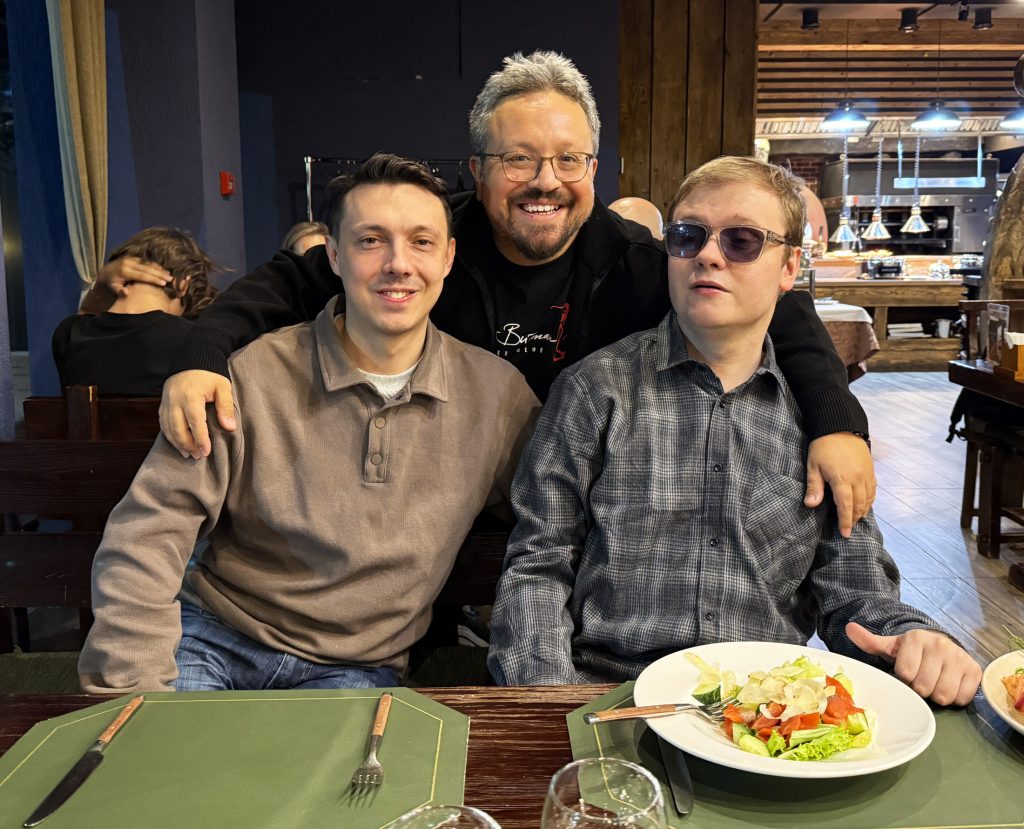
Anyone who has listened to Butman’s music a few times knows that bass is at the heart of his music. The bass is always tuned high, and the bassist’s storytelling aspect of his performance is very reliable. Butman trusts bassist Nikolai Zatolochniy, who used to live in New York for a while and who had the opportunity to develop himself in sessions in NY mostly. Zatolochniy lives up to this trust by creating wonders on both the electric bass and the double bass and participating in workshops to share his experience with youngers.
Eduard Zizak has been Igor Butman’s companion for over 25 years. He has spent most of his career with Butman. He is not only his stage partner but also a close friend with whom he enjoys spending time. He is an intelligent, solution-oriented person who is a good listener and has a very high positive energy, both musically and in his social life. Zizak’s energy greatly influences the orchestra’s tension. We heard that Zizak worked wonders on stage with the large orchestra, especially on the last day of the festival.

Fantine is fluent in Spanish cause Spanish is her mother tongue, due to her Dominican Republic heritage. Consequently, she contributed greatly to the Brazilian music repertoire with both her warmth and command of the language. Fantine has a powerful stage presence for sure, drawing attention to herself with her intonation, vocal control, and experience whenever I have seen her singing with Butman’s band. She is an excellent singer and humble person for sure.
Igor Butman Moscow Jazz Academy: Bright Future of Russian Jazz
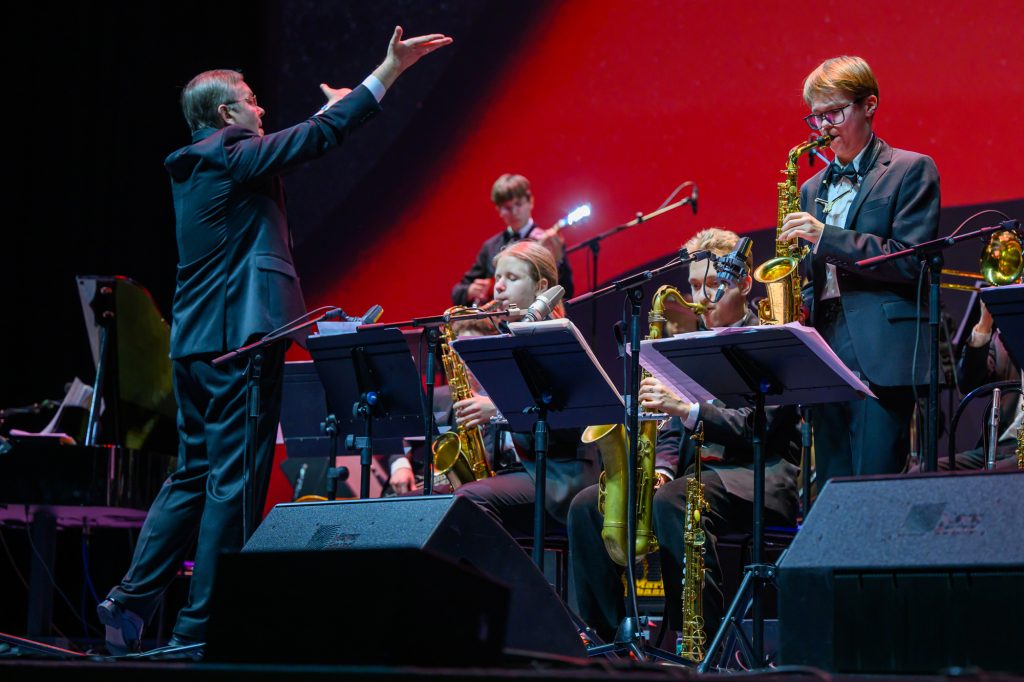
On the evening of November 8, the Jazz Academy Grand Orchestra, conducted by Pavel Ovchinnikov, Honored Artist of the Russian Federation, took the stage for the first concert. The musicians are Утков Игорь Семенович, Гмызин Тимофей Александрович, Грушевич Полина Анатольевна, Дмитренко Иван Михайлович, Дорофейчик Илья Ярославович, Дремлюга Анастасия Алексеевна, Ивашин Алексей Григорьевич, Исаков Илья Евгеньевич, Карпинский Егор Викторович, Королев Сергей Вадимович, Куликова Милана Артемовна, Литовченко Давид Николаевич, Мазур Артём Алексеевич, Мельников Денис Алексеевич, Рогожин Никита Глебович, Слюсаренко Михаил Андреевич, Соболев Глеб Александрович, Трифонов Михаил Алексеевич, Федосеев Лев Алексеевич, Фокас Григорий Евгеньевич ve Михаил Бручеев. The young musicians, who received rigorous training at the academy in Moscow, impressed me with their energy, diligence, and maturity. I particularly enjoyed the bass, drums, guitar, saxophone, trombones, and piano. Another beauty that caught my attention during the concert was the way the master conductor and trombonist of the Moscow Jazz Orchestra, Pavel Ovchinnikov, directed the concert, guiding the audience at many points, especially during the applause after the solo. Creating, teaching, and spreading jazz culture, which we greatly admire and unfortunately have not been able to achieve in our country, does not happen by chance; it requires conscious effort. I commend it.
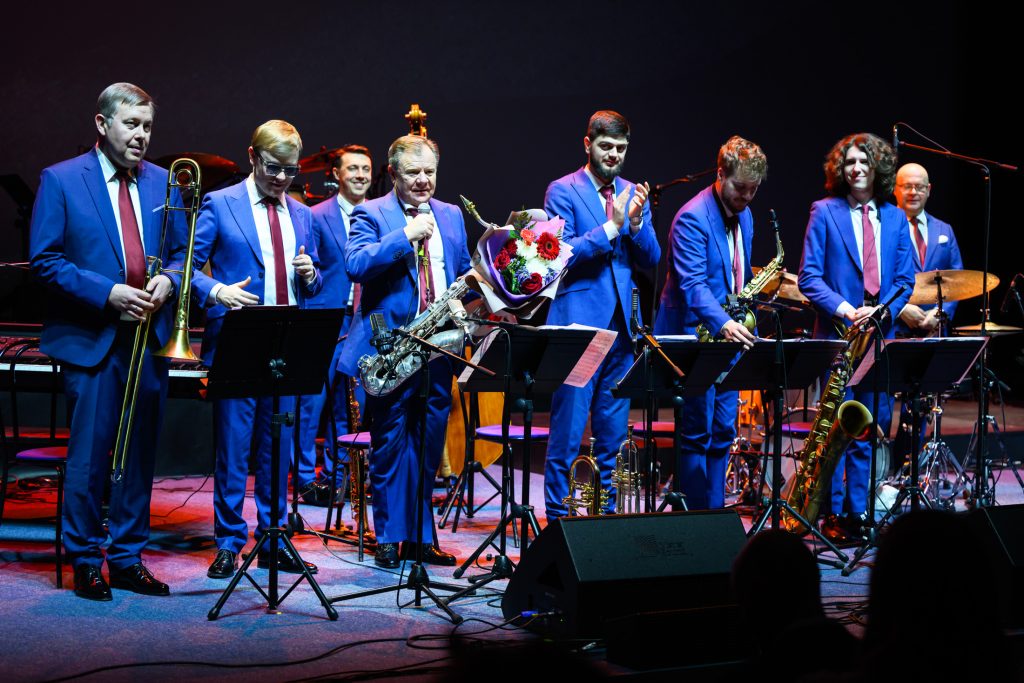
We listened to Igor Butman’s orchestra, which we had seen with the quartet on the first night, this time in octet form with Pavel Ovchinnikov, Anton Chekurov, Konstantin Boytsov, and Grigor Panosyan, performing Russian traditional music and original compositions by Chekurov and Okkuratov.
Although he is the lead alto saxophonist of the Butman’s Moscow Jazz Orchestra, I first encountered Anton Chekurov on the 2024 album Ad Astra. When I was invited to speak at a listening session during the Moscow Jazz Festival’s Jazz Across Borders panel, I heard this piece, and I can already say that it won my utmost admiration for both its speed and technical mastery. We talked a lot about music and chess mastery and quickly became friends. If you listen carefully to Chekurov’s solos, you’ll notice a similarity. Repetitive solos may seem ordinary at first glance and evoke a sense of déjà vu, but over the course of a career, when structured correctly over time, they also have the potential to become the musician’s signature sound. Ultimately, I have no doubt that this will evolve into a unique sonic signature. Please take note of Chekurov’s name; I’m certain he’ll gain international recognition soon..

Baritone saxophonist Konstantin Boytsov and Grigor Panosyan, despite being in their 20s, are hardworking and talented enough to outshine many masters. I have seen him lots of times in different festivals around and the most attractive one was Panosyan accompanied Stefano Di Battista, a guest at this year’s Moscow Jazz Festival, and gave a delightful performance, mingling with the audience. I believe that Panosyan’s success is also due to his ability to critique himself well. While he is on the road or backstage, he watches his own solos, discusses the right and wrong parts with his orchestra colleagues, and constantly strives to improve. I admire both of them a lot.
The festival featured not only concerts, but also workshops and discussions held at the Symphony Hall. Vocal discussions included Fantine, Pavel Ovchinnikov’s master class on “The Art of Jazz Performance,” and Mikhail Brucheev’s “Performance Challenges in Trumpet Playing: The Path to Improvisation,“ a creative meeting with Russian People’s Artist Igor Mikhailovich Butman, a master class from the Juan Horlendis Band on ”Afro-Cuban Rhythms. Creating a Community Arrangement,” and the practices of playing jazz on the double bass with Nikolai Zatolochniy attracted great interest from Sakhalin music lovers.
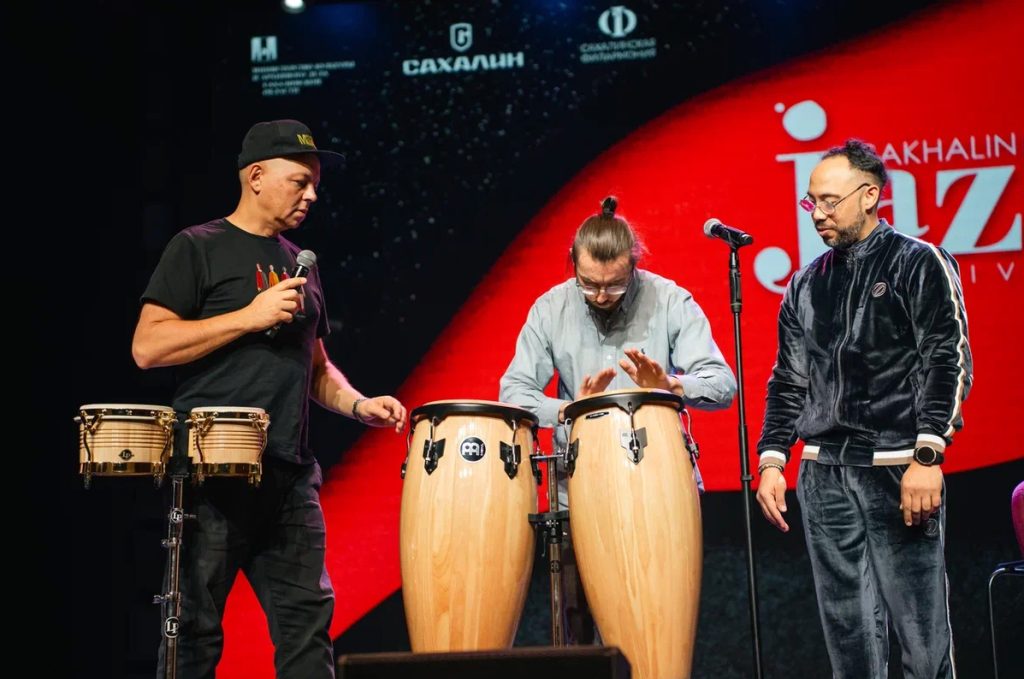
On the evening of November 9, at the first concert of the night, Puerto Rican bassist and vocalist Juan Horlendis, whom I nicknamed “The Real Entertainer,” was on stage with one of the best Latin orchestras in Russia. I had previously seen Horlendis performing in St. Petersburg Jazz Festival, thrilling the audience, and then I saw him again at the Butman Club. Once again, excitement, tempo, and full force fun. When Horlendis starts playing, the audience simply can’t stop the dance. The audience particularly enjoyed his exchanges on stage with his drummer, Danil Prokopyev. Horlendis said that he came to warm up Sakhalin with music from Cuba, an island of freedom, because both Cuba and Sakhalin are islands and therefore share similarities.
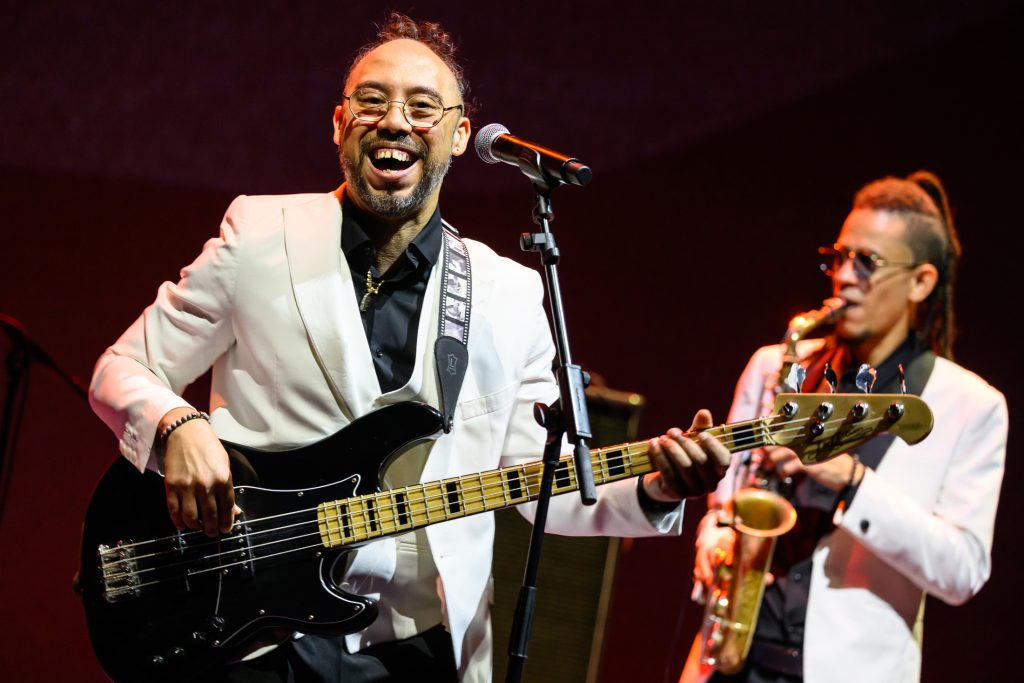

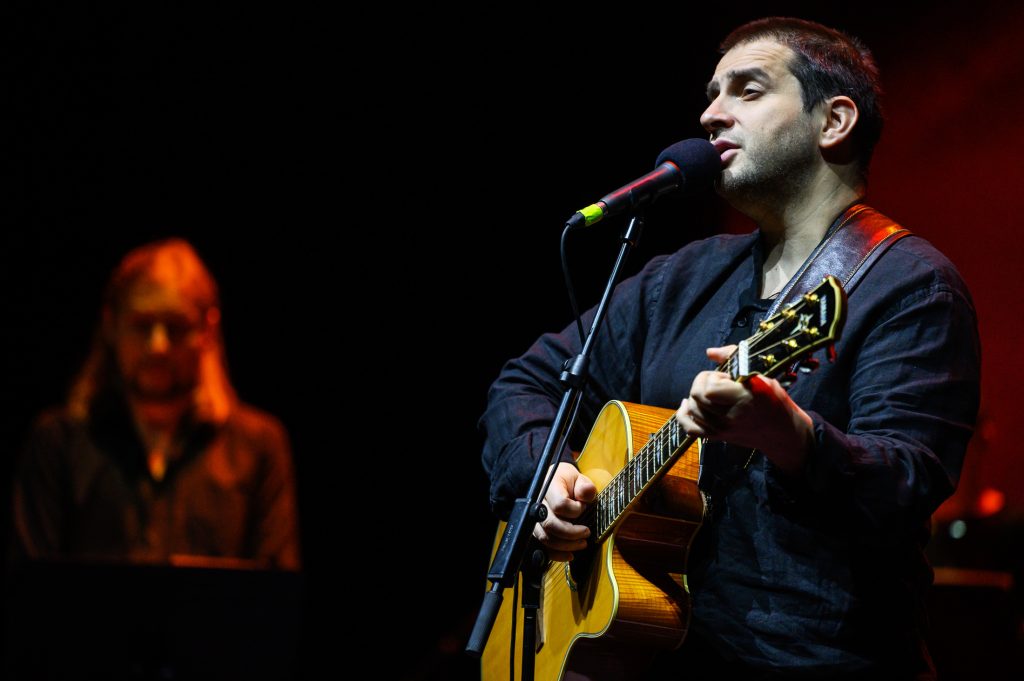
The second concert of the night featured Serbian-born vocalist and guitarist Peter Nalitch was on stage with his orchestra. Nalitch comes from a family of architects and is himself an architect, a well-educated intellectual with a strong command of literature. His mastery of literature has given him a powerful command of language, which has enabled him to produce witty songs about life. Nalitch, who also represented Russia in the Eurovision Song Contest in 2010, reached a large fan base with his song “Guitar,” which went viral on YouTube. I heard his Balkan music or pop rock music live for the first time and really liked his orchestra. Although Nalitch typically performs in a rock orchestra format, for this festival, they incorporated brass instruments, resulting in a performance that blended jazz improvisations and better suited the festival’s name. That was a fun discovery for my musical library.
On the final evening of the festival, I listened to “Peter and the Wolf” narrated by renowned actor Viktor Dobronravov, featuring a performance by Igor Butman and the Moscow Jazz Orchestra. The performance included an updated version of Sergei Prokofiev‘s musical fairy tale “Peter and the Wolf,” featuring Kristina Krit‘s original jazz arrangements. This new interpretation of the beloved fairy tale allowed us to appreciate the boundless scope of Sergei Prokofiev’s music and how familiar characters from childhood can be flawlessly voiced by the instruments of a jazz orchestra. I had previously seen this project at its premiere at the Jazz Sessions Festival, narrated by Sergey Stepanchenko, and was deeply impressed back in days. It has magnificent arrangements and a solid script whose limitless adaptability has been proven time and again around the world. While watching the concert, I imagined hearing this work performed by the masterful voice of our renowned actor Selçuk Yöntem on the stage of the invaluable Akra Jazz Festival, which introduced me to Butman. I hope we will have the opportunity to experience this project live in Turkey one day.
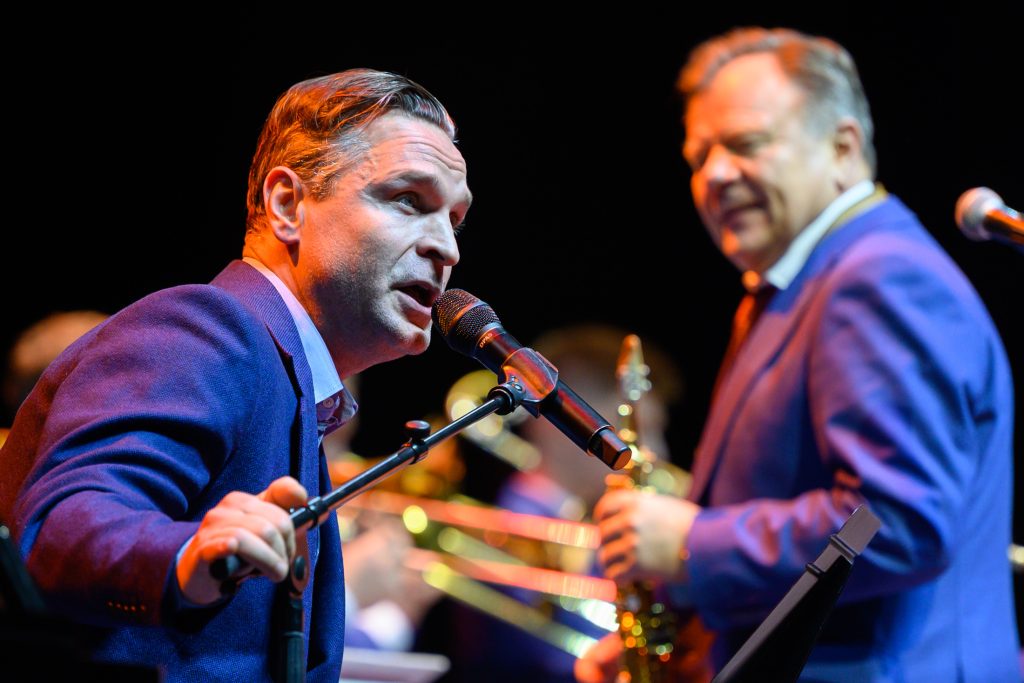
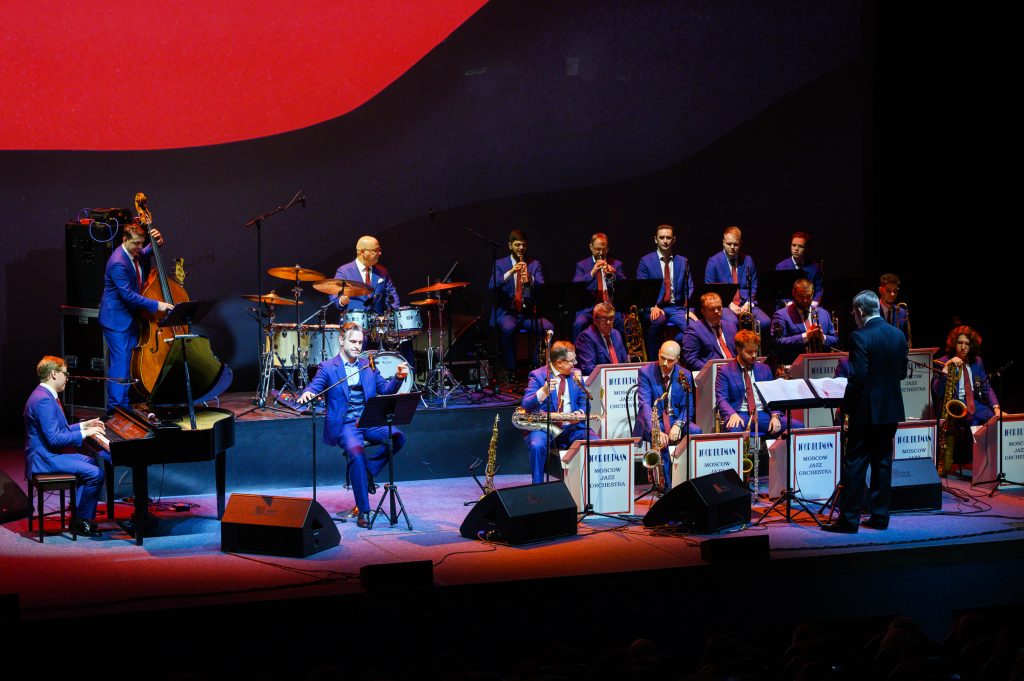
Moskova Jazz Orchestra musicians are Бутман Игорь Михайлович, Затолочный Николай Игоревич, Зизак Эдуард Витальевич, Аккуратов Олег Борисович, Чекуров Антон Алексеевич, Морозов Илья Александрович, Никитин Даниил Александрович, Шевнин Николай Павлович, Бородин Олег Николаевич, Гимазетдинов Сергей Равильевич, Середа Андрей Сергеевич, Паносян Григор Урартович, Зыль Андрей Владимирович, Северов Владислав Витальевич, Бойцов Константин Александрович, Карпенко Алексей Олегович, Овчинников Павел Леонидович, Басов Константин Николаевич
Thanks to the Sakhalin Jazz Festival, I had the opportunity to strengthen the ties I had previously established with the Russian jazz community and prepare more comprehensive content. As we entered Russia, a country considered a closed society, I witnessed once again how respectful and friendly they are in terms of cultural elements and social life. Many thanks to my friends from the team, Моисеенко Елена, Ляхова Елизавета, Роман Христюк, Антон Сергеев, Ильвиша Лакхина for their precious help. See you again soon!
More content about Igor Butman is HERE
Igor Butman’s page is HERE


