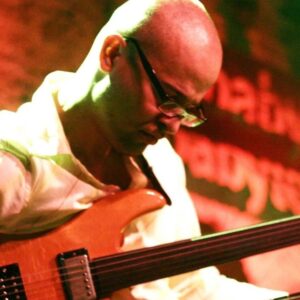


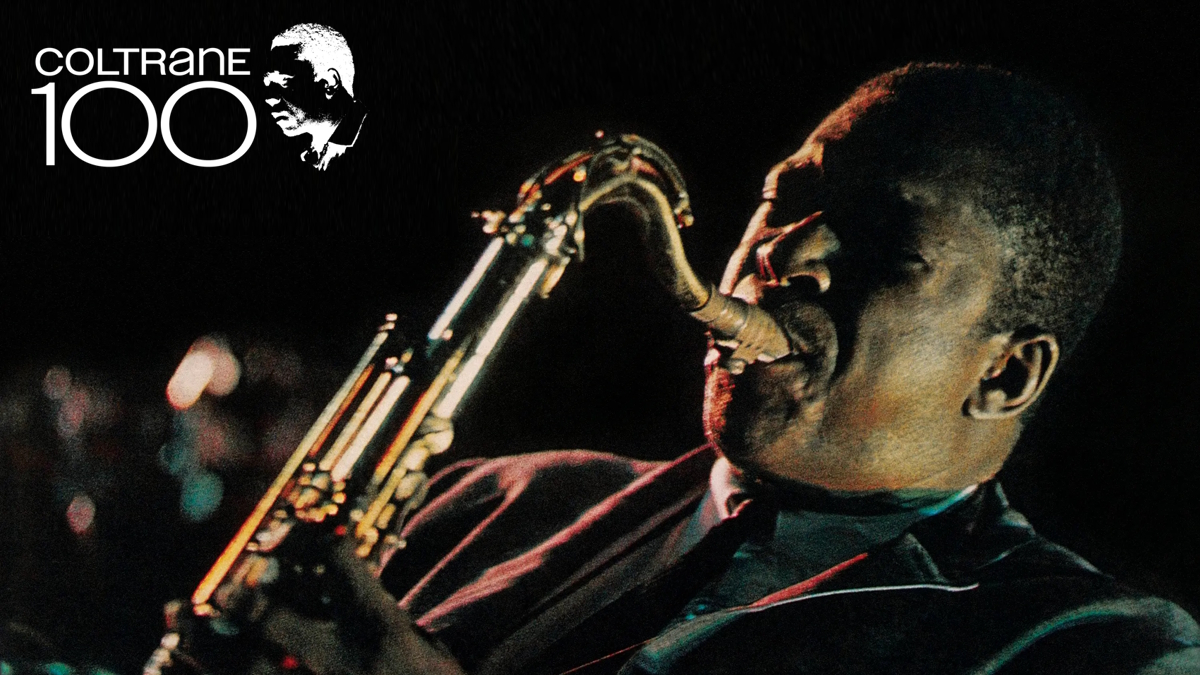
Dark Blue Notes: What did you feel or think the first time you listened to John Coltrane?
Timuçin Şahin: I heard him on the radio when I was a teenage rock player. I was at boarding school at Izmir Ozel Turk Koleji, and I was hiding under the blanket at night with a radio because radios were not allowed in the dormitory back then. I had a pair of headphones, and I was listening to a radio program called Günümüzde Caz, curated by the wonderful Hülya Tunçağ.
I had no idea what jazz was. I stumbled upon the program by chance, and then I think I made a note of it and started listening to it on the same night every week. The program was not specifically about Coltrane, but its opening music was so cool, very catchy to a young rocker’s ear. It was a fragment of “Mr. P.C.” by Trane. That was the very first time I heard him.
I did not understand a lot of what was happening musically, but I knew immediately that there was an energy there that I wanted to follow.
Dark Blue Notes: What is it about Coltrane’s music that still amazes you today, or that you find hard to explain?
Timuçin Şahin: There are a couple of things: his sound, his forward motion in his thinking, his personality not only as an artist but as a human being, and of course his ability to generate so much poetry across the different phases of his work.
One would inevitably study him to understand how past, present, and future can coexist at the same time. With Coltrane, it is not only about studying the instrument, harmony, improvisation, or only the mechanics of the music. It is also about witnessing a past we did not live, imagining the future, and sensing the possibilities of the unknown.
Dark Blue Notes: In your opinion, what was Coltrane’s true revolution: his playing style, his composition, his approach to improvisation, or his overall approach to music?
Timuçin Şahin: The Coltrane that everyone knows and adores would already represent all the things you mentioned, and I would agree with them without hesitation.
But his later period is much less known and very much neglected. In that period, he became one of the artists who redefined what we call avant-garde. I am talking about the Meditations period and later Interstellar Space, albums that are not really picked my up by the mainstream. For him to arrive at that kind of real-time compositional design through years of playing the tradition, while pushing the envelope inch by inch in every musical phase, is remarkable.
As Coltrane’s musical vocabulary developed, the unified metric phenomenon that was initially present in his music gradually gave way to a multiplicity of rhythmic entities that could exist independently from one another. I still think that from where he started to where he ended his musical journey, each step opened a new chapter in improvisational and compositional possibilities.
So my answer would be: his true revolution was his unending progress, and his ability to create something new in each period of his life.
Dark Blue Notes: Do you think Coltrane found what he was looking for?
Timuçin Şahin: Hard to say. One would never know. But one thing is for sure: he was after a sonic and spiritual experience that would reflect his personality and his search.
His search transformed the music itself, and that very search became part of the sound and his legacy. That is maybe why we still hear a sense of urgency, depth, and space at the same time in his music.
Dark Blue Notes: Why is Coltrane still important, and how does he manage to speak to us today?
Timuçin Şahin: He is important on many levels. He is one of the co-creators of the language we still use. In that sense, he is almost like a master teacher, or like a revelation that keeps unfolding.
His early period is a true apprenticeship. He became a master of the tradition, and in a way helped define it through his sound, articulation, harmonic imagination, and intensity. But what is even more remarkable is that once he reached this uncanny level of authority, he was brave enough to let go and move somewhere else. That is very rare.
You don’t study Coltrane only because you want to imitate him or learn certain devices. You study him because he shows what kind of responsibility comes with sound. His musical vocabulary kept widening, moving across very different sonic worlds, from consonance to extreme dissonance, from clarity of tone to noise and other expressive elements.
For me, that is why he still speaks to us. It is not nostalgia or simply historical admiration. Each time he reaches mastery, he turns it into another question. He never stopped becoming.
■
Dark Blue Notes’ta John Coltrane@100
John Coltrane resmi web sitesi
Timuçin Şahin resmi web sitesi